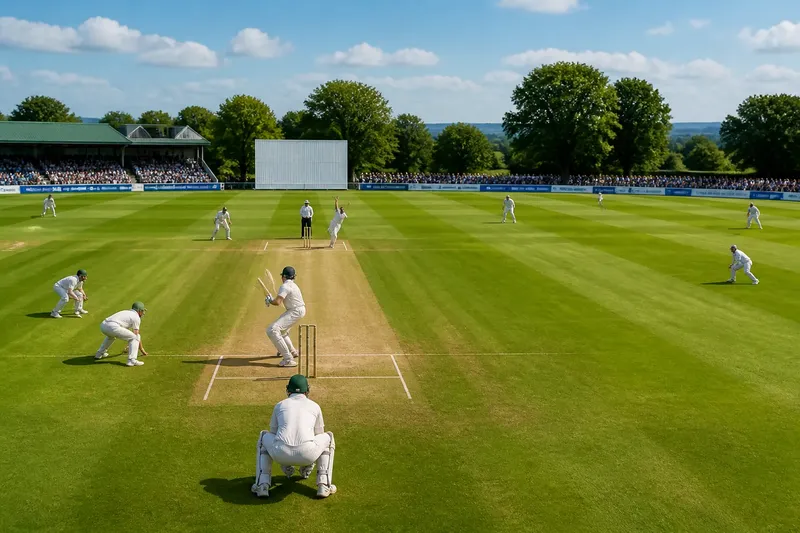
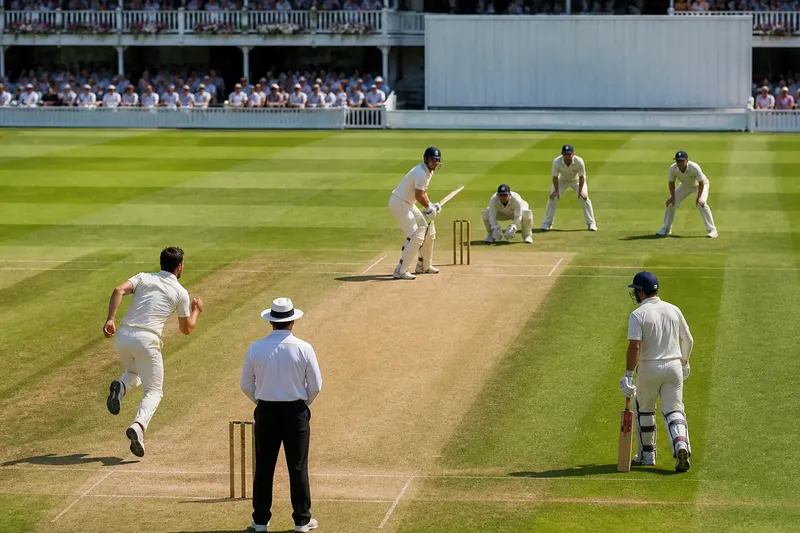
How Cricket Grounds Changed from Village Greens to Enclosed Grounds
Cricket grounds changed as shared greens gave way to more defined playing spaces. Learn how boundaries, fences and local use shape what a ground means.
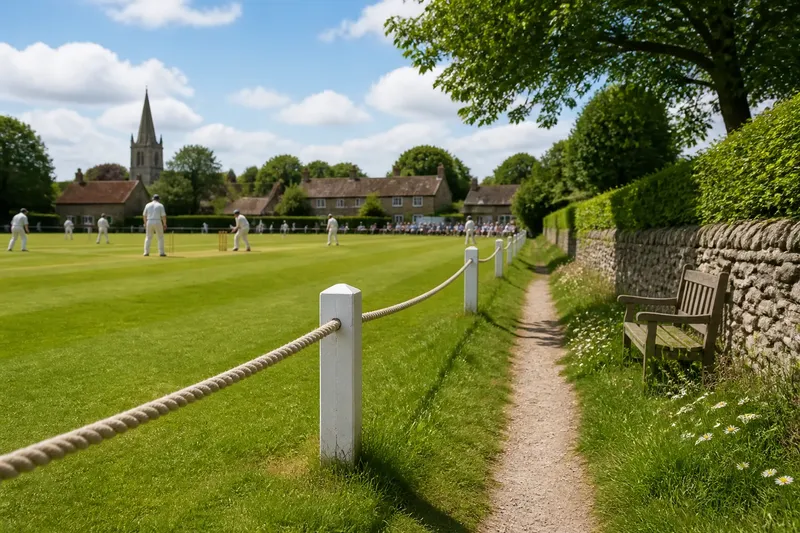
Why did cricket move from village greens towards enclosed grounds, and what changed besides the view? The history of cricket grounds is a story of shared open space becoming more clearly organised for play, spectators and the other uses around it.
Greens and shared space
Early cricket was often played on village greens and commons: open spaces used for more than one purpose. A match could take shape around familiar landmarks such as a hedge, a tree or the edge of usable grass. The setting was recognisable to local players, but its limits were not necessarily fixed from one occasion to the next.
That flexibility suited a game arranged within a community’s existing space. It also left practical questions to resolve: where the ball counted as out, which ground features were obstacles, and how play should adapt when other people needed to cross or use the area.
More defined grounds
As cricket became more organised, grounds increasingly needed to accommodate regular fixtures and spectators as well as play. A marked boundary made the playing area easier to identify and helped distinguish the field from nearby paths or other activities. Ropes, posts or other visible markers could make that line clear without enclosing the whole site.
Fences and hedges served a different purpose. They could separate a cricket space from roads, gardens or neighbouring uses, while also making the ground feel like a more distinct place. An enclosure did not automatically define the scoring boundary: that still depended on the match arrangements.
Why enclosure mattered
Enclosure reflects a shift in how a ground was organised, not simply a change in its appearance. A shared green could remain open to several uses, while a more established cricket ground might provide clearer separation for players and spectators. The balance depended on the site and its surroundings; an open space could still host cricket if its playing area and routes were clear.
Imagine a village club playing on a broad field crossed by a public footpath. The organisers agree to mark the boundary inside the usable grass, keep the path outside the playing area and direct spectators to a separate edge. The resulting arrangement gives players a clearer line for decisions while leaving the shared route available.
How do grounds work?
Did every village green have fixed limits?
No. The playing area could depend on local landmarks and the agreement for that match. That flexibility meant the same open space could be adapted to changing conditions and other users.
Does an enclosure define the boundary?
Not by itself. A fence may mark the edge of a site, while a separate rope or line governs play. Check the local match arrangements to see which marker counts.
Why mark a boundary?
A visible marker makes the edge of the field easier for players and spectators to follow than an ambiguous feature such as a path or hedge. It can also help organise play on a shared site without requiring a permanent fence.
Can an open green still host a match?
Yes, if the playing area is agreed and the surrounding use can be kept clear of play. Organisers should account for paths, roads and other activities before setting the boundary.
Reading the ground
When assessing a cricket ground, check each feature and decide what it means for the match:
- Observe whether the grass is even and usable; if it is obstructed or unsuitable, choose a clearer area, or relocate the match.
- Observe whether the boundary is visible from the field; if it is hard to see, add clear temporary markers, or agree unmistakable landmarks before play.
- Observe whether a path crosses the proposed playing area; if it does, move the boundary away from the route, or choose another space.
- Observe whether spectators would stand inside the field of play; if they would, set a separate viewing area, or reposition the playing area.
- Observe whether a fence and a rope mark different edges; if they do, tell players which one governs the match, or revise the arrangement so there is no ambiguity.
- Observe whether other activities share the ground; if they could conflict with fielding, agree clear separation, or select a different time or location.
For a casual match, permanent fencing is not worth the effort when a clear agreement and temporary markers will do. But a rope cannot solve every problem: if a road or busy route makes the site unsuitable, use another area or arrange a safer separation.
To understand how cricket grounds changed from village greens to enclosed grounds, look at how each site balances play with its surroundings. The boundary tells you how the match treats the edge of the field; the enclosure tells you how the wider space has been set apart and used.